
Look at a photograph by László Moholy-Nagy today, a full century after it was made, and it still feels jarringly modern. It doesn’t sit politely on the page. It might make you dizzy, tilting the world on its axis to look down a vertiginous stairwell. It might be a ghostly abstraction, a swirl of light and shadow that looks like an X-ray of a dream. Or it might be a portrait, but one where the face is fractured by mirrors or blasted into negative space.
In the 1920s, photography was still fighting a lingering battle to be taken seriously as “art,” often by imitating the gentle fuzziness of charcoal drawings or paintings. Moholy-Nagy had no patience for that. He was a Hungarian powerhouse of energy – a painter, sculptor, designer, and writer who landed at the Bauhaus and became one of its most influential teachers. He didn’t see photography as a way to document the world as it was. He saw it as a prosthetic device for the modern human.
Moholy-Nagy believed that our naked eyes were obsolete. They were too passive, too used to the lazy habits of Renaissance perspective. The modern world – a place of speeding trains, skyscrapers, electricity, and industrial machinery – required a new kind of looking. He called this the “New Vision” (Neues Sehen).
And to achieve this New Vision, he didn’t just pick up a camera. He fundamentally took photography apart and reassembled it as a medium of pure light.
Light as a New Material
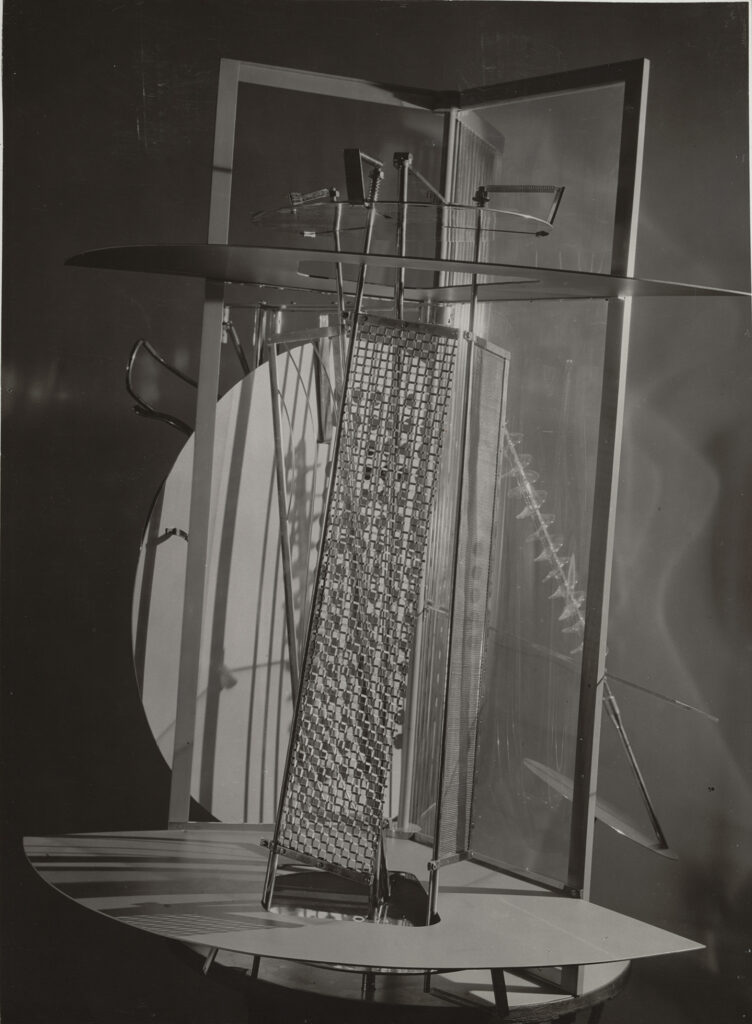
To understand Moholy-Nagy’s photography, you have to understand his obsession with light itself. For centuries, artists had used paint or clay as their raw materials. Moholy-Nagy argued that the defining material of the 20th century was light.
He didn’t mean the light that illuminates a bowl of fruit so you can paint it. He meant light as a physical substance that could be molded, bent, blocked, and intensified. In his theoretical writings – which are incredibly enthusiastic, sometimes bordering on manic – he declared that we had entered an age of “light architecture.”
For Moholy-Nagy, the camera wasn’t a recording device; it was a light modulator. The photographic plate wasn’t a canvas; it was a trap designed to catch photons. This might sound like semantic hair-splitting, but it changed everything about how he worked. It freed him from the obligation of having a “subject.” If light is the subject, you don’t need a mountain or a beautiful face. You just need shadows and brilliance.
This philosophy led him down two distinct, but connected, paths in photography. The first required no camera at all.
The Camera-less Image: The Photogram
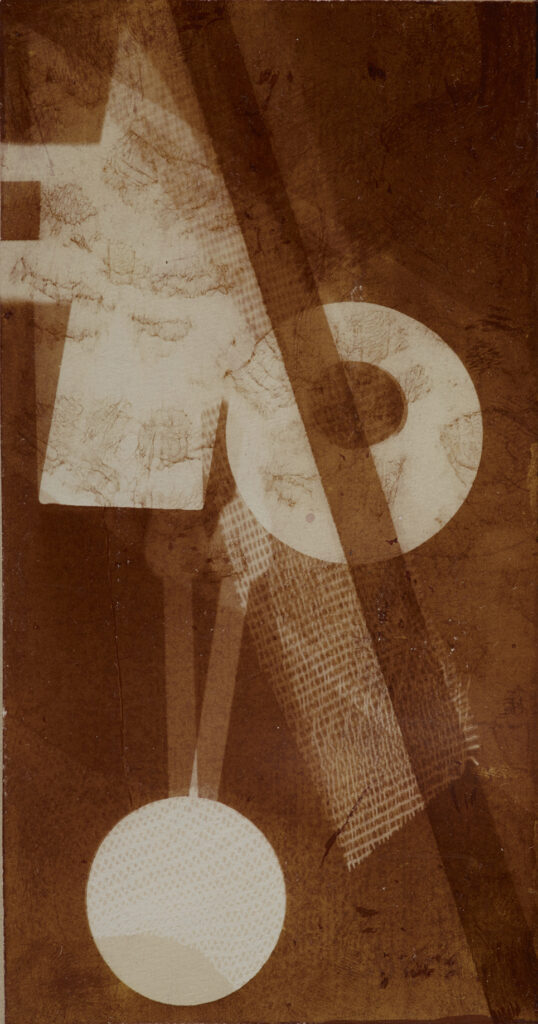
Moholy-Nagy hated the baggage that came with the camera – the technical fiddling, the rules of focus, the historical weight of perspective. He wanted a direct line between light and sensitive paper.
His solution, explored simultaneously with his partner Lucia Moholy (an incredible photographer in her own right who is often unfairly sidelined in his story), was the “photogram.”
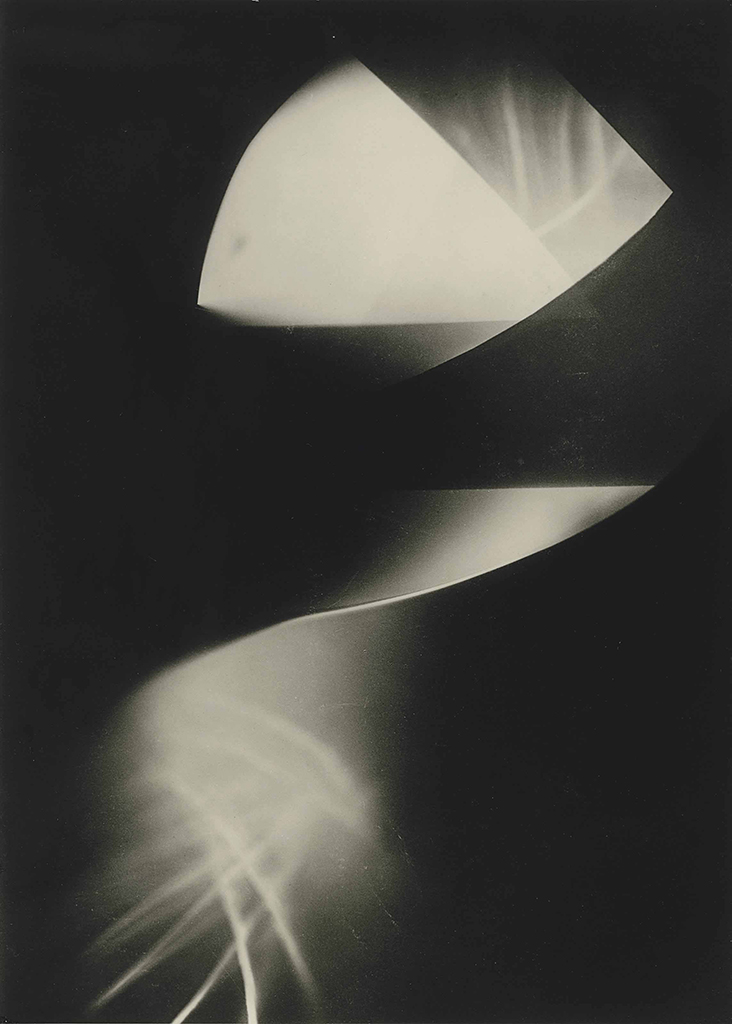
The technique itself was simple, almost childish. You go into a darkroom, place objects directly onto a sheet of photographic paper, and turn on a light bulb for a few seconds. Where the object rests, the paper remains white. Where the light hits, it turns black. In between, depending on the transparency of the objects, you get an infinite range of grays.
Other artists, like Man Ray, were experimenting with this (he called them “Rayographs”), but they often used it to create witty, surrealist visual puns. Moholy-Nagy was after something different. He wanted to create abstract spaces that couldn’t exist in reality.
He used industrial detritus – gears, springs, wire mesh – alongside organic shapes like hands or leaves. He played with glass and liquids to refract the light. The results are deeply mysterious. Looking at a Moholy-Nagy photogram feels like looking at the blueprint of a ghost. Objects lose their solidity and become floating shapes of luminescence. A metal gear is no longer heavy; it’s a hovering ring of white light.
In these works, there is no “up” or “down.” Perspective is obliterated. The image seems to recede into an infinite, velvety blackness, yet the white shapes push forward aggressively toward the viewer. It is photography stripped of its duty to represent reality, allowed finally to just be light and form. He called this “painting with light,” and it remained for him the purest expression of photographic potential.
The Camera as an Extension of the Eye
If the photogram was about pure abstraction, Moholy-Nagy’s camera work was about aggressively attacking reality.
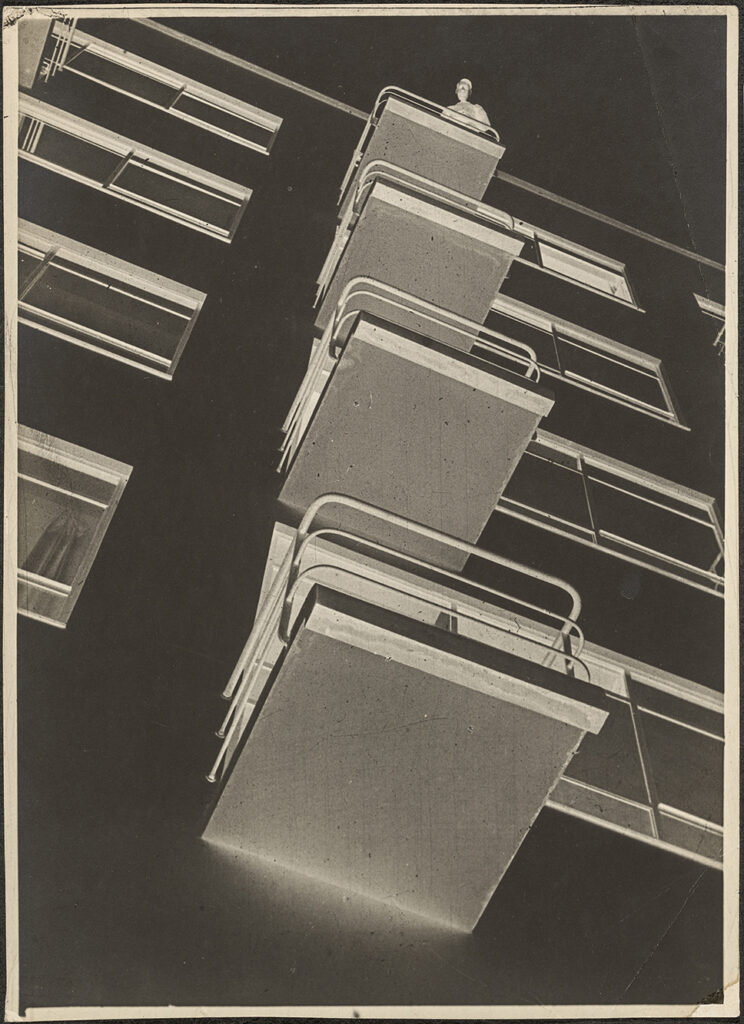
When he did pick up a camera (often a portable Leica, which allowed for spontaneity), he treated it as a weapon against visual boredom. He despised what he called the “worm’s-eye view” – the standard, eye-level perspective that we all walk around with. He felt it made us passive consumers of our environment.
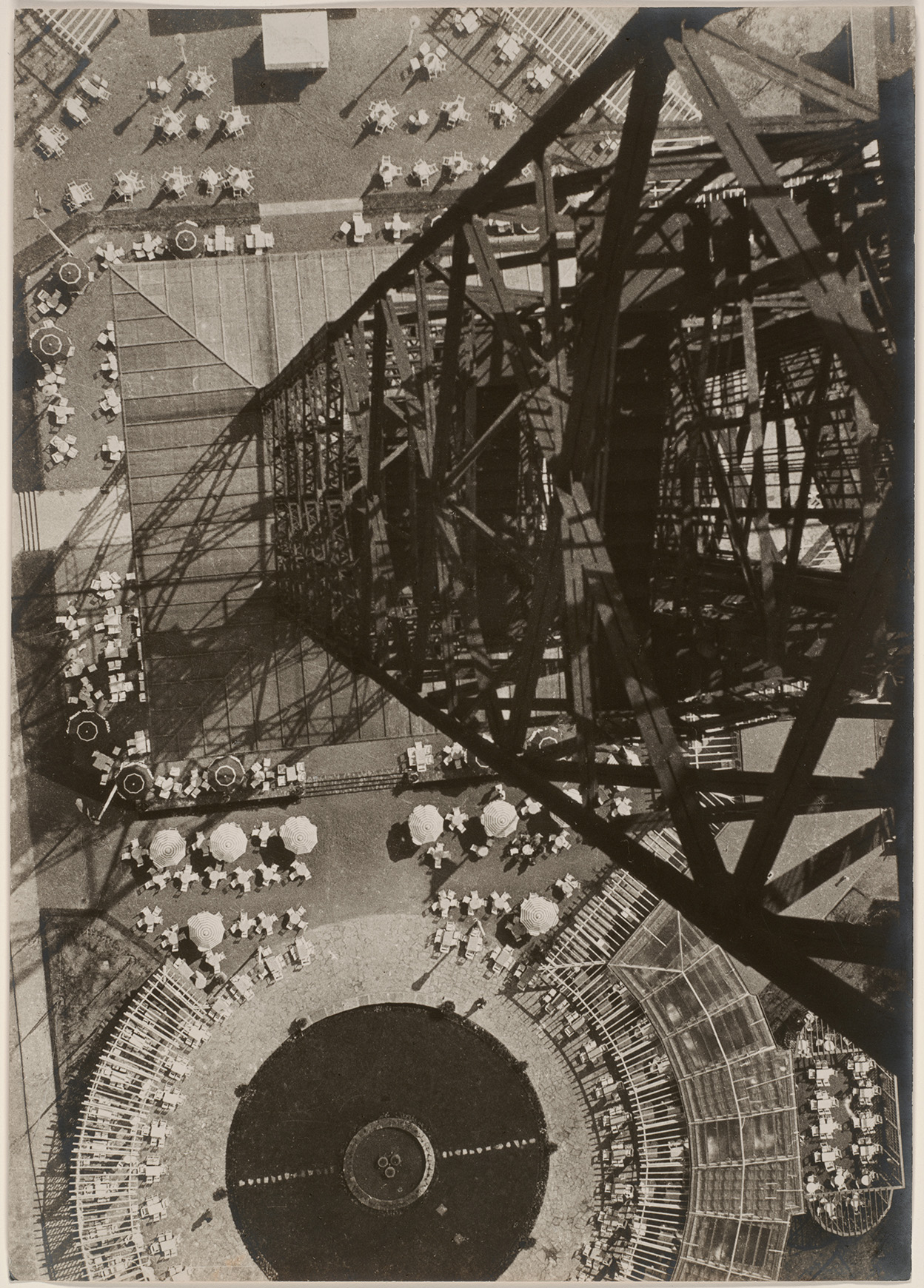
To shock the viewer into seeing the world anew, Moholy-Nagy sent his camera high up and low down. He climbed the newly built radio towers in Berlin and Paris to shoot straight down through the girders. The resulting photos are terrifying collages of industrial geometry. The ground below becomes an abstract map; people are reduced to tiny dots. It induces a sense of vertigo, a feeling of being unmoored from the comfortable earth.
He loved the aesthetics of the machine age. He photographed bridges, shipyards, and the metallic skeletons of new buildings. But he didn’t photograph them to celebrate their engineering; he photographed them to find the hidden abstract patterns within their structures. A close-up of a ship’s drainage pipes becomes a study in repeating circles and metallic textures.
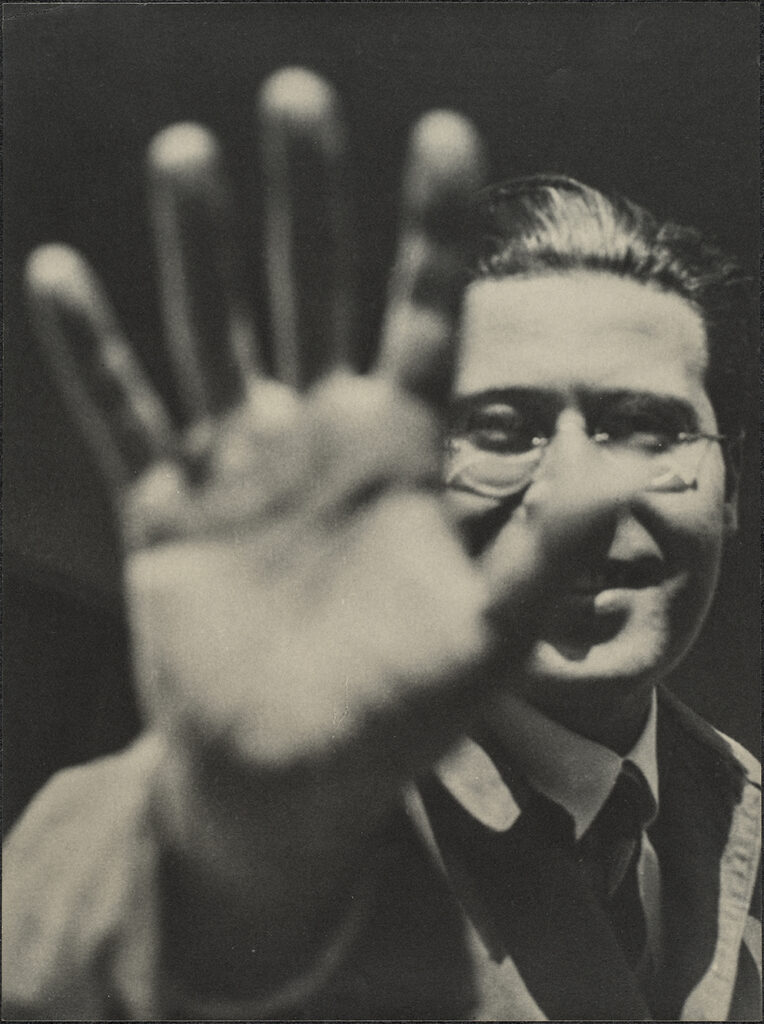
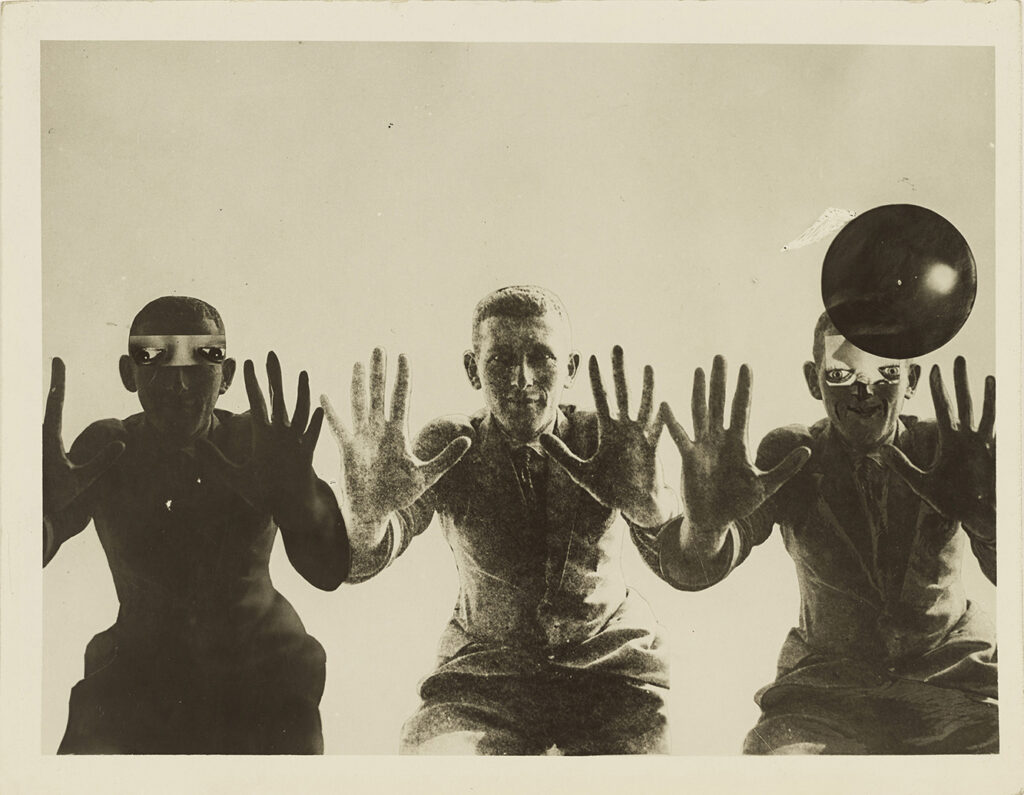
He also turned the camera on people, but never straightforwardly. He used mirrors to fracture portraits, creating cubist puzzles of faces. He experimented with negative printing, reversing the tones so that skin became dark and the eyes glowed white, turning his subjects into electric specters.
One of his most famous techniques was the double exposure. He would layer images on top of one another – a face over a landscape, a piece of machinery over a nude body. These weren’t just accidental overlaps. They were calculated attempts to compress time and space, to show the frenetic simultaneity of modern life in a single frame. He was trying to capture the feeling of standing on a busy city street corner, overwhelmed by sensory input.
The Bauhaus and Typophoto
It is impossible to separate Moholy-Nagy’s photography from his environment at the Bauhaus during the 1920s. He was surrounded by architects, industrial designers, and typographers who were all trying to strip away ornamentation to find the functional core of things.
Moholy-Nagy applied this functionalism to communication. He was a pioneer of what he called “Typophoto” – the synthesis of typography and photography.
Before this era, photos in magazines or advertisements were usually framed separately from the text. They were illustrations sitting next to words. Moholy-Nagy crashed them together. He believed the photograph was text – it communicated information faster and more viscerally than words ever could.
He began designing book jackets, posters, and magazine layouts where photos were cut out, angled, heavily cropped, and integrated directly with bold, sans-serif typefaces. He treated the photograph as a graphic element, just another building block in the design. This approach is so standard in advertising and media today that we don’t even notice it, but in 1925, it looked like an explosion on the page. It was dynamic, urgent, and undeniably modern.
A relentless Experimenter
What makes László Moholy-Nagy so endearingly human, despite all his high-minded theorizing, was his restless, almost childlike curiosity. He was never satisfied that he had found the “answer.”
He was a technological utopian. He truly believed that machines, if mastered by artists, could liberate humanity and create a better society. Photography wasn’t just a hobby; it was part of a moral imperative to teach people how to live in the 20th century.
When the Nazis rose to power, Moholy-Nagy, like so many Bauhaus masters, was forced to flee. He eventually landed in Chicago, where he founded the New Bauhaus (later the Institute of Design), transplanting his radical ideas about vision to American soil.
In America, he continued to experiment. Even on his deathbed in 1946, suffering from leukaemia, he was still studying light and form, still trying to see something new.
The Legacy of the New Vision
Why does Moholy-Nagy matter today? In the era of Instagram and Snapchat, we are all constantly documenting our lives. We are drowning in images.
Moholy-Nagy would probably have loved the smartphone camera. He would have loved the immediacy of it, the ability to manipulate filters and share images instantly. But he would have challenged us not to just use it to record our lunch or take a standard selfie.
He challenges us still to look at the familiar and make it strange. To look up from our phones at the towering glass structures above us, or down at the abstract patterns of pavement cracks beneath our feet.
He taught us that photography isn’t about capturing what is already there. It’s an active process of construction. Every time a filmmaker uses a drone to get a dizzying overhead shot, every time a graphic designer melds a photo into a block of text, every time a photographer uses a reflection to distort a face, they are walking on a path cleared by Moholy-Nagy.
He wasn’t just taking pictures. He was engineering a new way for human beings to inhabit their own eyes. He took the camera out of the Victorian parlour and thrust it into the machine age, demanding that it do more than just remember – he demanded that it see.
All images: László Moholy-Nagy. Courtesy of Moholy-Nagy Foundation, http://www.moholy-nagy.org