
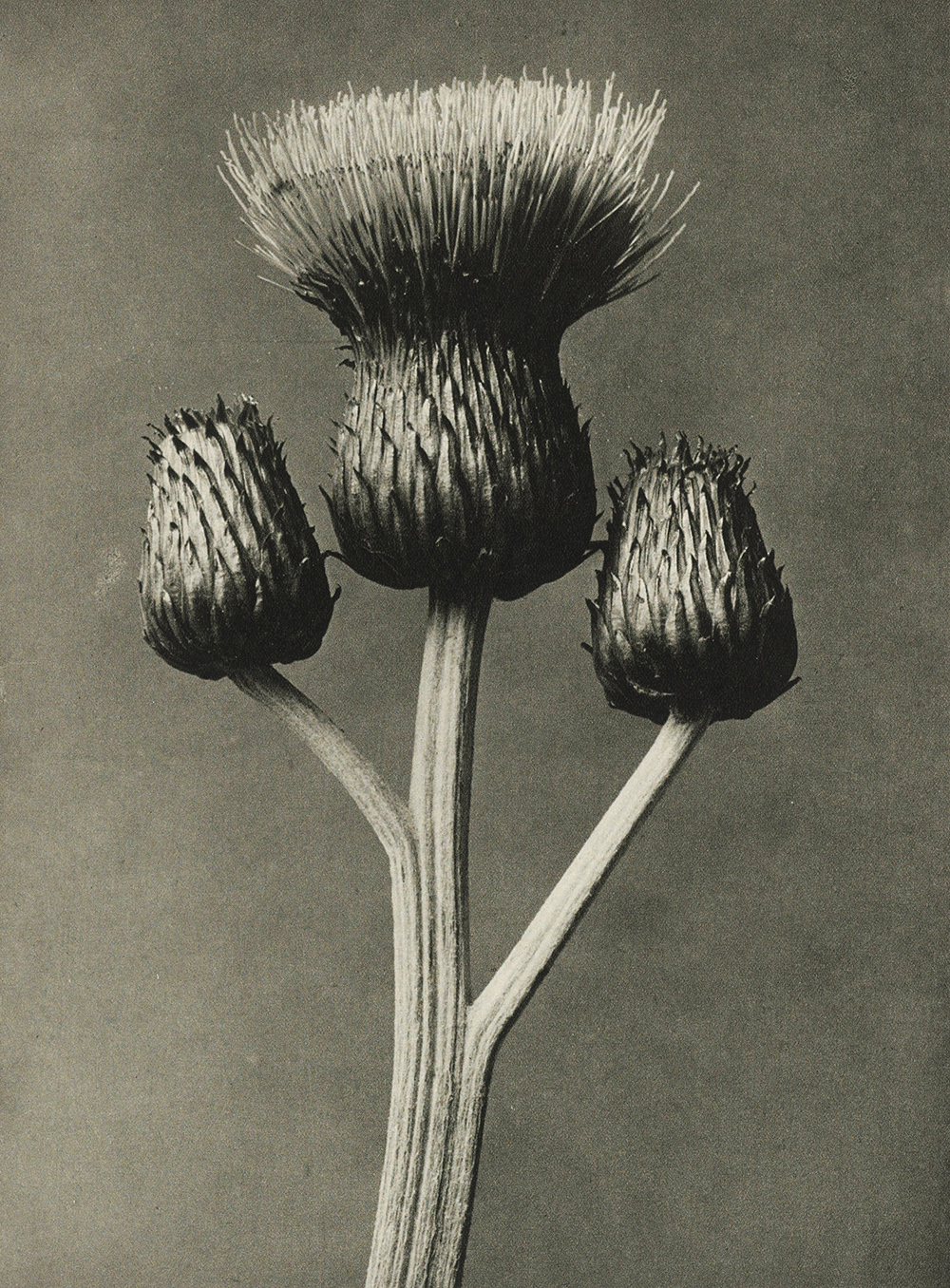
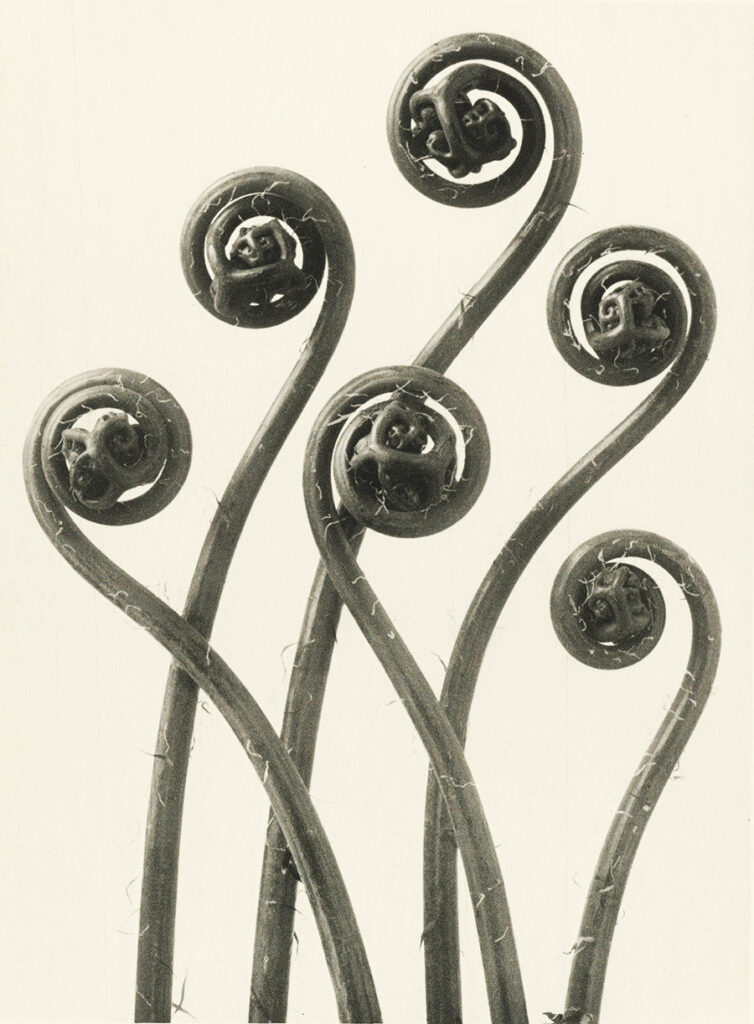
There is a strange coldness to a Karl Blossfeldt photograph. When you look at one of his plants – a fern unfurling like a bishop’s staff, or a horsetail shoot standing rigid like a skyscraper – it doesn’t feel organic. It doesn’t feel like something that grew in the dirt, drank water, or turned toward the sun.
It feels like it was forged.
In the history of photography, Karl Blossfeldt is a magnificent anomaly. He wasn’t a bohemian artist hanging out in cafes with the Dadaists. He wasn’t a young radical trying to burn down the establishment. He was a 63-year-old professor of design who had spent the last thirty years in a dusty classroom, obsessively photographing weeds with a camera he built himself.
He didn’t take these photos for galleries. He didn’t take them for fame. He took them as teaching aids to show his students that the best industrial designer in history wasn’t a human being – it was nature itself. Yet, in doing so, he accidentally created some of the most startlingly modern images of the 20th century, stripping the sentimentality out of flowers and revealing the brutal, architectural machinery hidden inside.
The Iron in the Soul
To understand why Blossfeldt’s flowers look like metal, you have to look at his hands. Before he was a photographer, and before he was a professor, Blossfeldt was a teenage apprentice in an ironworks foundry in the Harz Mountains of Germany.
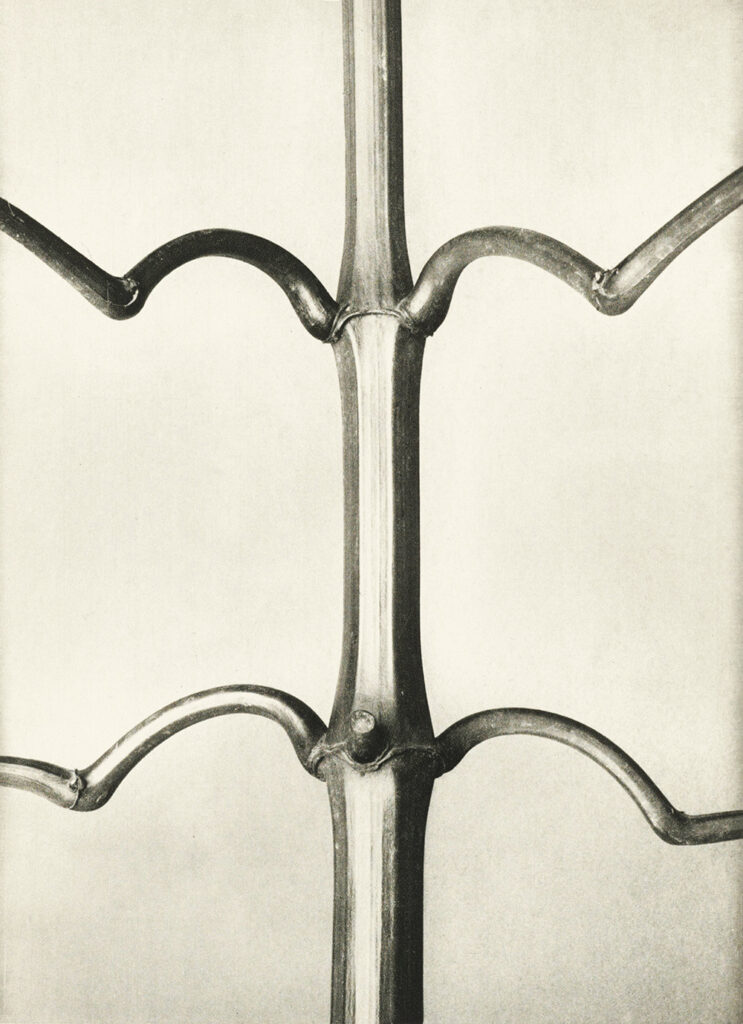
For years, his world was one of molten metal, sparks, and the heavy, rhythmic clanging of the hammer. He learned to make wrought iron grilles and gates – structures that were strong, rigid, and often decorated with scrolling plant motifs.
This training rewired his brain. He didn’t look at a plant and see “beauty” in the romantic sense. He didn’t care about the velvety texture of a petal or the vibrant color of a bloom. He looked at a plant and saw structure. He saw engineering. He saw how a stem bore the weight of a flower head, just as a column bears the weight of a roof. He saw how a leaf curled to channel water, just as a gutter channels rain.
When he eventually moved to the School of the Museum of Decorative Arts in Berlin to teach design, he carried this “iron vision” with him. He wanted his students to design ornaments, architectural details, and ironwork. But he realized that the plaster casts and dry drawings they were using as references were dead. They lacked the tension of real life.
He needed better models. And since he couldn’t bring 6,000 fresh plants into the classroom every week, he decided to preserve them. Not by pressing them in a book, where they would be flattened and lifeless, but by photographing them.
The Proletarian Garden
There is a wonderful humility to Blossfeldt’s process. In an era where “Fine Art” usually meant painting portraits of aristocrats or photographing grand landscapes, Blossfeldt went looking for his subjects in the dirt.
He avoided the manicured perfection of botanical gardens. He had no interest in rare orchids or expensive roses. Instead, he rode his bicycle or took the train out to the edges of Berlin – to the “proletarian areas,” as he called them. He scoured the sides of railway tracks, the dusty embankments, and the forgotten patches of scrubland.
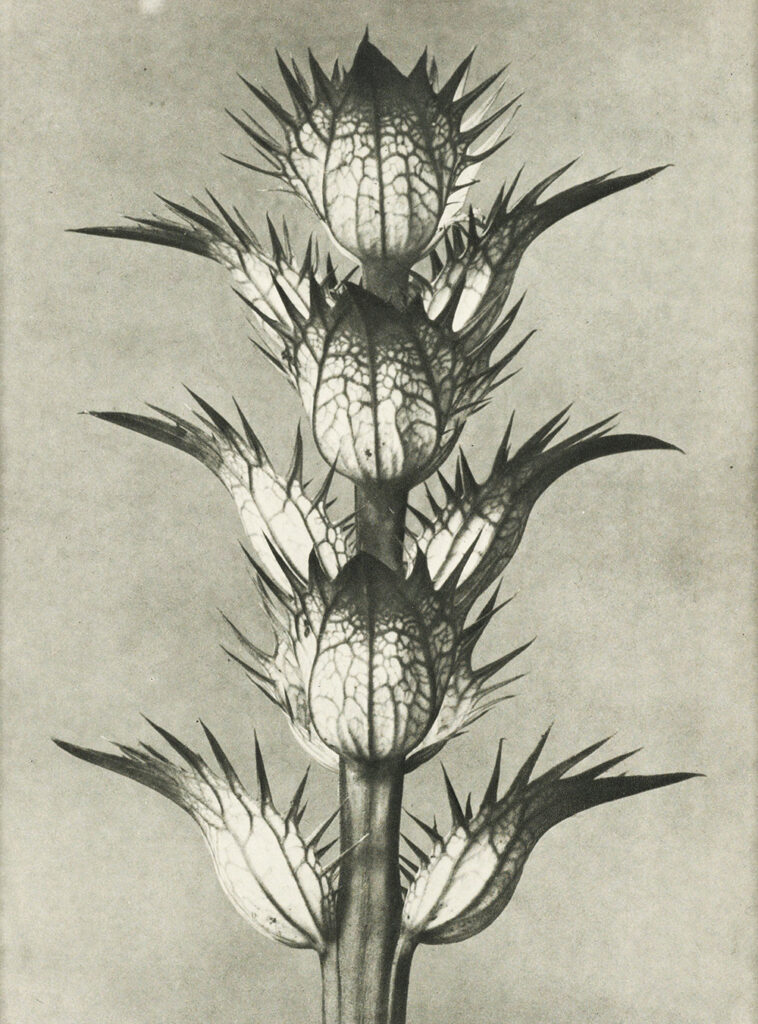
He was hunting for weeds. He collected the outcasts of the floral world: thistles, pumpkin tendrils, horsetails, and common ferns. He looked for the plants that were “carelessly overlooked,” realizing that their diminutive scale hid a treasure trove of forms.
Once he had his specimens, he would return to his studio, where the real work began. Blossfeldt wasn’t using a sleek Leica or a high-end studio camera. He used a homemade wooden box camera outfitted with custom magnifying lenses that he had cobbled together. It was a clumsy, heavy apparatus, but it allowed him to do something revolutionary: he could magnify these tiny weeds up to 30 times their actual size.
He stripped away all context. There is no soil in a Blossfeldt photo. There is no sky, no horizon, no other plants. There is only the specimen, isolated against a flat, gray background, lit by a diffuse, even light. He sometimes even pruned or retouched the plants, removing “imperfect” leaves to emphasize the geometric ideal he was hunting for.
The result was a total transformation. Under his lens, a chaotic weed became a monument.
The Shock of the Old
For three decades, this massive archive of thousands of glass plates sat in his studio, seen only by his students. To Blossfeldt, they were tools, effectively no different than a ruler or a protractor.
But in the late 1920s, the Berlin art world was shifting. The emotional, messy expressionism of the post-war years was fading. A new movement was rising: Neue Sachlichkeit (New Objectivity). Artists were looking for clarity, precision, and a sober, unsentimental view of reality. They were obsessed with technology, machines, and mass production.
Enter Karl Nierendorf. Nierendorf was a gallerist and a tastemaker who stumbled across Blossfeldt’s archive and realized he was looking at a goldmine. He didn’t see “botany.” He saw modern art.
In 1928, Nierendorf published a selection of Blossfeldt’s images in a book titled Urformen der Kunst (Art Forms in Nature). It was an instant, international sensation.
The public was stunned. They looked at these images and didn’t see plants. They saw totem poles. They saw gothic cathedrals. They saw the spiraling iron railings of a staircase. They saw bishop’s staffs and modernist skyscrapers.
Critics like Walter Benjamin were mesmerized, writing that Blossfeldt had revealed the “optical unconscious” – visual truths that were invisible to the naked eye but revealed through the machine of the camera. The Surrealists loved him because his plants looked like aliens; the Modernists loved him because his plants looked like machines.
Visualizing the Invisible
To truly appreciate the “Blossfeldt effect,” you have to pause and look at the images closely.
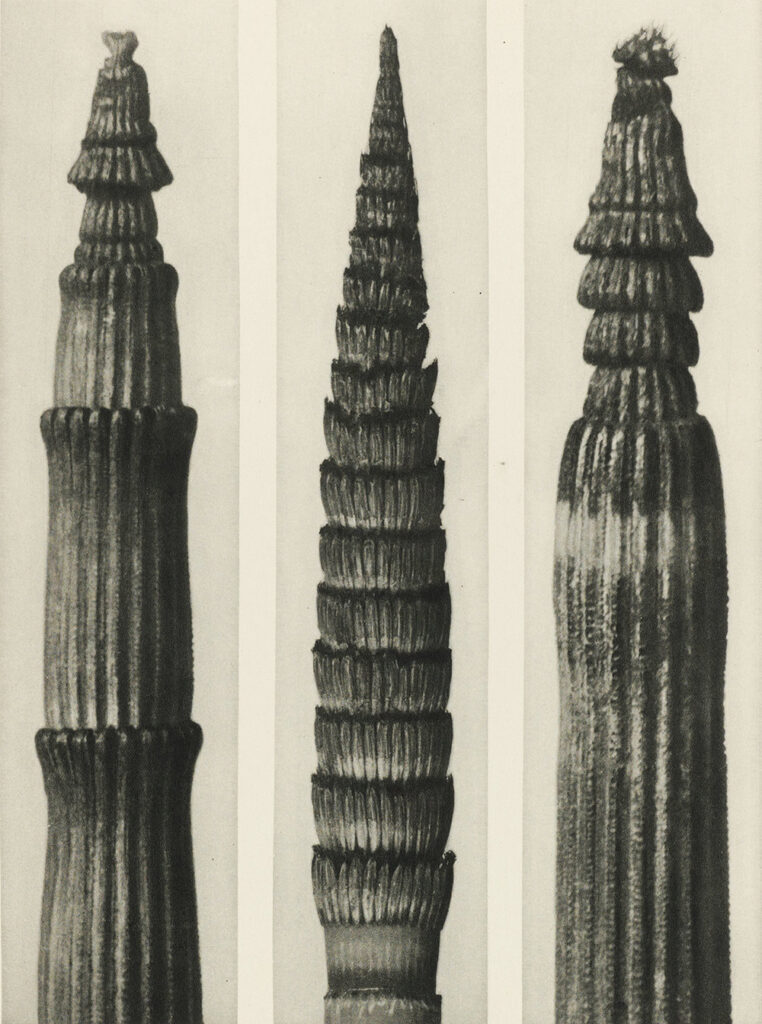
Take his photograph of the Winter Horsetail (Equisetum hyemale). In the wild, this is a scraggly, prehistoric-looking reed you might step on without noticing. In Blossfeldt’s photo, it is a towering column of architectural segments. It looks like a skyscraper designed by a minimalist architect. The joints of the stem look like precision-milled pipe fittings. It is pure geometry.
Or look at his images of ferns. We think of ferns as soft, leafy, forest floor decorations. Blossfeldt photographed them while they were still coiled tight in their infancy. Magnified, they look like the head of a cello, or the heavy iron scrollwork on a Berlin balcony. You can feel the tension in the spiral, the stored energy waiting to spring.
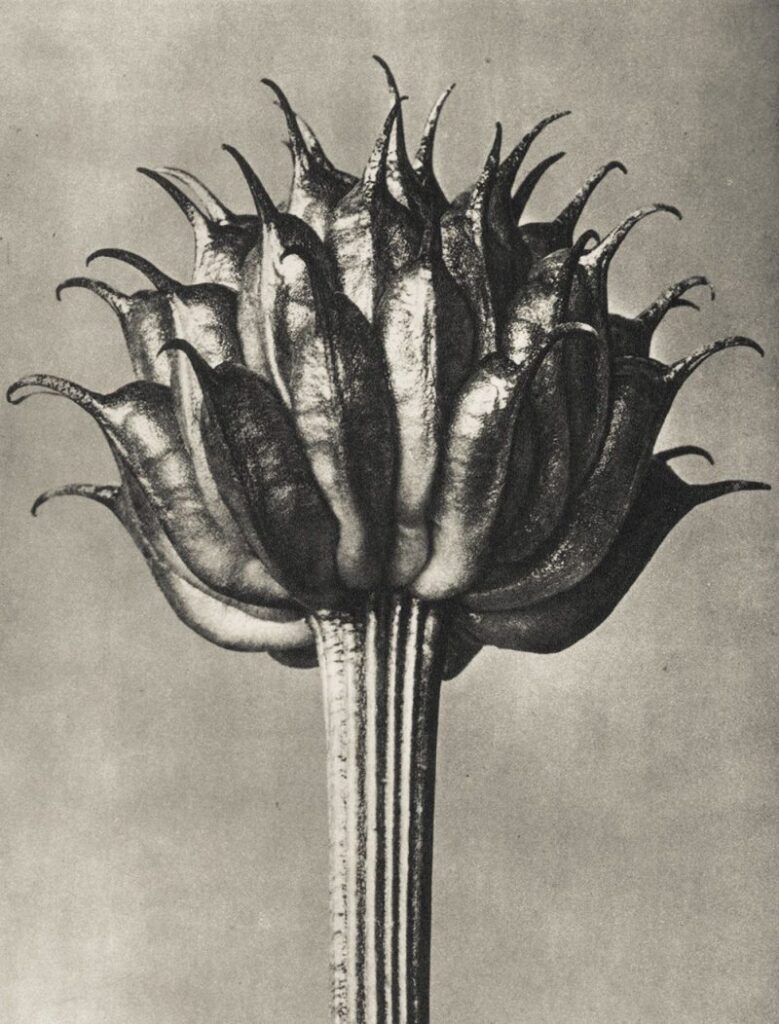
Even the dried leaves he photographed, shrivelled and dead, take on a new life. They look like hammered copper or twisted bronze. By removing the colour – the green that signals “nature” – and presenting them in stark black and white, he forces us to focus solely on the line and the volume.
He proved that nature is the original engineer. Long before humans built the Eiffel Tower or the Gothic arches of Cologne Cathedral, a weed by the side of the railroad track had already solved the problem of how to build a structure that is both light and strong.
The Quiet Legacy
Karl Blossfeldt died in 1932, just four years after his book made him famous. He produced two more books before he passed – Wundergarten der Natur and the posthumous Wunder in der Natur – but he remained, at heart, a teacher.
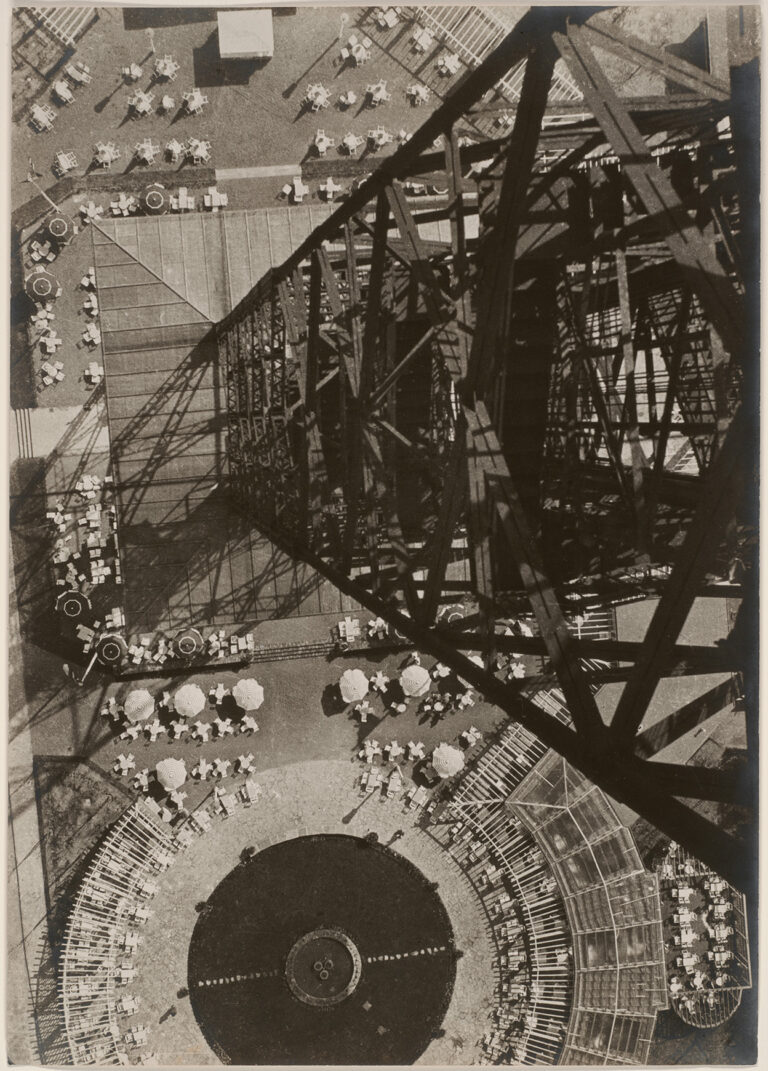
It is easy to group him with the other titans of 1920s photography, like László Moholy-Nagy or August Sander. They were all working in Germany at the same time; they were all interested in a “New Vision.” But while Moholy-Nagy was climbing radio towers to find a new angle on the world, Blossfeldt was simply staring deeper into what was already right in front of him.
Moholy-Nagy used the camera to distort and invent; Blossfeldt used it to reveal.
Today, in an age where macro photography is a standard feature on every iPhone, it is difficult to imagine just how radical these images felt in 1928. We are used to seeing the veins of a leaf or the texture of pollen. But Blossfeldt’s images still hold a specific power that modern macro photography often lacks.
Modern macro photos often feel like scientific curiosities – super-sharp, brightly coloured, clinical. Blossfeldt’s photos feel like portraits. They have a gravity and a solemnity to them. Because he wasn’t just zooming in; he was composing. He was treating that thistle head with the same respect a portrait photographer treats a face.
He teaches us that you don’t need to travel to the exotic corners of the earth to find something profound. You don’t need to invent a new reality. You just need to look at the weeds in the cracks of the pavement, and really, truly see them. You need to look until the green fades away and the architecture remains.
Blossfeldt showed us that the world is built of stronger stuff than we think. He showed us that inside every fragile flower, there is a skeleton of iron waiting to be found.